
5 Mistakes GMAT Test-Takers Make on Data Insights (DI) — And How to Avoid Them
January 29, 2026
The GMAT's Data Insights (DI) section is a game changer. It doesn't just test whether you can interpret charts or do basic math…it checks whether you can reason through data under time pressure, often across multiple formats including tables, graphs, logic puzzles, and multi-source reasoning.
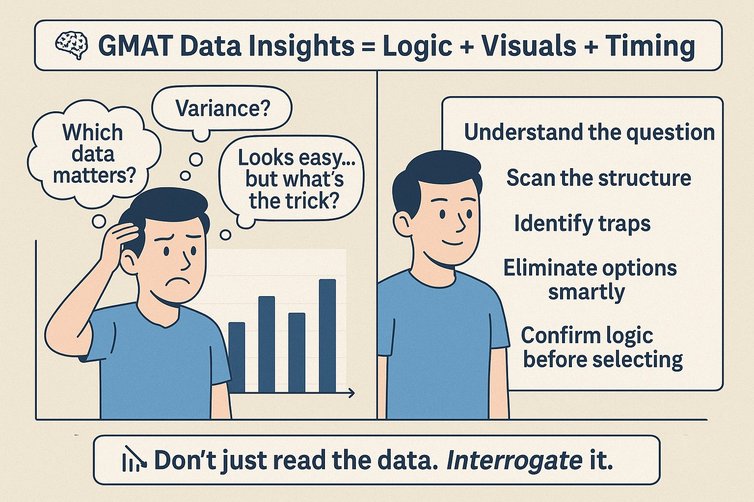
But here's the problem: most test-takers are still approaching DI like it's a glorified IR section from the old GMAT. It's not, and it is imperative for test-takers to understand the differences between the two sections in order to avoid score-lowering mistakes. Here are five key mistakes we at Manhattan Review see over and over again:
- Treating DI as a "Math-Lite" Section
Some test-takers assume that DI is easier than Quant because many questions seem to ask for data interpretation rather than number crunching. That's a trap you should avoid at all costs.
The mistake: Believing DI is more about charts and less about reasoning.
The reality: GMAT DI often disguises multi-layered logic problems as simple data analysis. Just because a bar graph is involved doesn't mean the question is visual. The hard part is often buried in conditional logic or subtle inferences.
What to do: Treat every DI question like a mix of CR and Quant problem — ask what the question is really testing and don't get seduced by the formatting.
- Overlooking Precision in Drop-Downs and Two-Part Questions
Drop-downs and two-part questions may seem intuitive, but this is intentional on the part of the test creators and purposefully designed to fill you with false confidence. Only by learning to recognize this trap can you safely avoid it.
The mistake: Rushing to match answers or doing mental math without fully isolating variables.
The reality: Many errors here come not from misunderstanding, but from overconfidence. Options are designed to reward careless clicks.
What to do: Double-check your logic before submitting — especially in multi-select and two-part questions where a single misjudgment tanks the whole item.
- Not Tracking Logical Conditions in MSR (Multi-Source Reasoning)
GMAT's MSR questions often feel like reading two or three tabs of contradicting data. And that's intentional, designed to confuse you and keep you mired in questions that don't lead to the correct answer and eat up your time.
The mistake: Treating each tab independently or missing the "if this, then that" structure.
The reality: MSR demands mental tab-switching and critical reconciliation of competing claims or data inconsistencies.
What to do: Before diving into answer choices, map the logic. Ask: What are the constraints? Are there any assumptions embedded in one tab that the other contradicts?
- Ignoring Time Management on Visual Interpretation
Charts and graphs may look approachable — until you find yourself stuck on one for four minutes. The longer you look, the less sense anything makes, resulting in frustration and a lot of wasted time.
The mistake: Spending too long decoding an unfamiliar visual.
The reality: The visuals aren't there to help — they're there to test whether you can quickly extract only what's needed.
What to do: Skim the visual first without diving into numbers. Ask: What type of visual is this (trend, comparison, distribution)? What does each axis represent? Only zoom into the detail after you've understood the overall structure.
- Answering Without Fully Understanding the Question Stem
Everyone knows time management is critical on the GMAT. But managing your time wisely means knowing when to go slower just as much as it means knowing when to work faster. Resist the temptation to jump into solving a problem before fully understanding what you're being asked to do.
The mistake: Jumping to the data table or chart before dissecting the actual question being asked.
The reality: GMAT DI stems are precise. A single overlooked word — like must vs could, or on average vs in total — changes everything.
What to do: Slow down and paraphrase the question to yourself before looking at the data. Ask: “What exactly is being asked here, and what kind of reasoning will this require?”
Final Thought
The Data Insights section of the GMAT isn't about obscure formulas or data wizardry. It's about your ability to reason clearly and act decisively amid cluttered information. It tests your ability to separate what matters from what is simply present, as well as your ability to avoid distractions and isolate a key component or components. If that reminds you of a boardroom decision-making session — that's the point. GMAT is testing how you think, not just what you know. Unlike tests based on rote memorization, this test requires you to consider information and make decisions, applying strategies to achieve results.
This can be a very different way of thinking for many people, particularly academic test-takers who pride themselves on their ability to quickly demonstrate what they know. But demonstrating what you know won't help you get a high score on the GMAT. The best way to become familiar with DI problems is by practicing them. The more you practice DI questions, the more familiar you will be with how they're written, and the better you'll be at identifying what you are being asked to do while pacing yourself so you can answer every question in the section. If you want to practice Data Insights questions, head over right away to our Free GMAT Practice Questions.