A soil bacterium was grown in liquid nutrient broth. Two experiments measured how the amount of growth depended on incubation temperature (Experiment 1) and on the amount of an added antibiotic (Experiment 2).
Researchers studied a single-celled bacterium grown in tubes of liquid nutrient broth. After a fixed incubation time, the amount of growth in each tube was measured as its optical density, the cloudiness of the broth measured with a light beam at 600 nm. Optical density rises as the number of cells rises, so a clear tube has an optical density near zero and a densely grown tube has a high value.
In Experiment 1, identical tubes were each inoculated with the same small number of cells and incubated for 24 hours, one tube at each of six temperatures: 5, 15, 25, 37, 45, and 55°C. No antibiotic was added. The optical density of each tube was then recorded (Figure 1).
In Experiment 2, all tubes were held at a single temperature, 37°C, and incubated for 24 hours. Before incubation, a different amount of an antibiotic was dissolved in each tube, giving concentrations of 0, 1, 2, 4, and 8 µg/mL. The optical density of each tube was recorded (Table 1). The minimum inhibitory concentration (MIC) is defined as the lowest antibiotic concentration that prevents visible growth of the culture (leaves the broth essentially clear).
Figure 1: Optical density after 24 h versus incubation temperature (no antibiotic added)
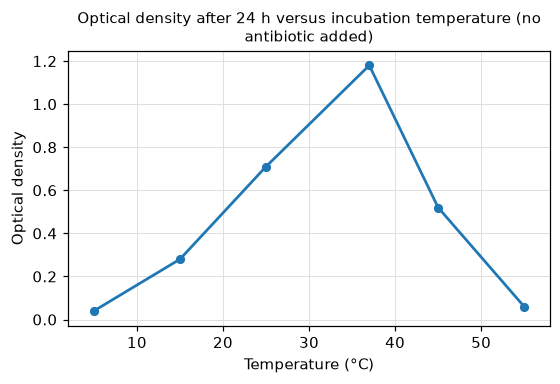
Table 1: Optical density after 24 h versus antibiotic concentration (temperature held at 37°C)
| Antibiotic concentration (µg/mL) | Optical density |
|---|
| 0 | 1.18 |
| 1 | 1.15 |
| 2 | 1.05 |
| 4 | 0.42 |
| 8 | 0.03 |