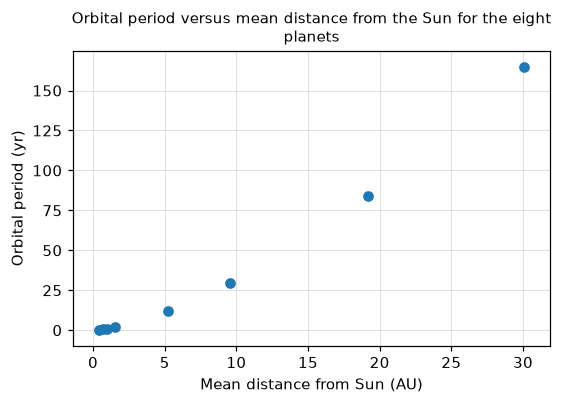
The eight major planets orbit the Sun at very different distances. Table 1 lists, for each planet, its mean distance from the Sun, its orbital period, and its mean temperature; Figure 1 plots orbital period against distance from the Sun.
The eight major planets of the Solar System travel around the Sun in nearly circular orbits at widely different distances. Distance is given here in astronomical units (AU), where 1 AU is defined as Earth's mean distance from the Sun. A planet's orbital period is the time it takes to complete one full orbit of the Sun—one "year" for that planet.
Mean temperatures in Table 1 are surface values for the four rocky inner planets (Mercury, Venus, Earth, Mars); for the four giant outer planets, which have no solid surface, the value listed is the temperature near the top of the cloud layer.
Table 1 lists these properties for each planet. Figure 1 plots each planet's orbital period against its mean distance from the Sun.
Table 1: Orbital and physical properties of the eight planets
| Planet | Distance from Sun (AU) | Orbital period (yr) | Mean temperature (°C) |
|---|
| Mercury | 0.39 | 0.24 | 167 |
| Venus | 0.72 | 0.62 | 464 |
| Earth | 1.00 | 1.00 | 15 |
| Mars | 1.52 | 1.88 | -65 |
| Jupiter | 5.20 | 11.9 | -110 |
| Saturn | 9.58 | 29.5 | -140 |
| Uranus | 19.2 | 84.0 | -195 |
| Neptune | 30.1 | 165 | -200 |
Figure 1: Orbital period versus mean distance from the Sun for the eight planets