When marble chips (calcium carbonate, CaCO3) are dropped into dilute hydrochloric acid (HCl), the two react to make carbon dioxide gas (CO2), water, and calcium chloride. Students measured how quickly the gas came off under different conditions.
Students studied the reaction between marble chips and dilute hydrochloric acid:
CaCO3 + 2HCl -> CaCl2 + H2O + CO2
In each trial the students added the same mass of similarly sized marble chips to the same volume of acid in a flask, then recorded the volume of CO2 released during the first 30 seconds. From this they calculated the initial rate of CO2 production, in cubic centimeters per second (cm3/s), before the reaction had time to slow down.
Experiment 1. The temperature of the acid was held at 20°C. The students ran four trials, changing only the concentration of the hydrochloric acid: 0.5, 1.0, 1.5, and 2.0 mol/L. The initial rates are shown in Table 1.
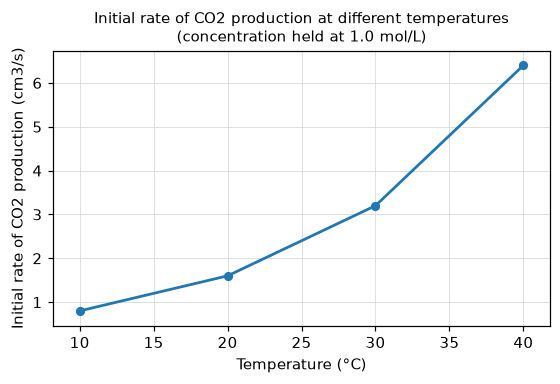
Experiment 2. The concentration of the acid was held at 1.0 mol/L. The students ran four trials, changing only the temperature of the acid: 10, 20, 30, and 40°C. The initial rates are plotted in Figure 1.
Table 1: Initial rate of CO2 production at different acid concentrations (temperature held at 20°C)
| Trial | Concentration of HCl (mol/L) | Initial rate of CO2 production (cm3/s) |
|---|
| 1 | 0.5 | 0.8 |
| 2 | 1.0 | 1.6 |
| 3 | 1.5 | 2.4 |
| 4 | 2.0 | 3.2 |
Figure 1: Initial rate of CO2 production at different temperatures (concentration held at 1.0 mol/L)