A food chemist prepared aqueous solutions of sucrose (table sugar) at six concentrations and measured two physical properties of each solution at a constant temperature of 20°C.
Dissolving sugar in water changes how heavy a given volume of the liquid is and how easily it flows. To study these effects, a chemist prepared six sucrose solutions ranging from 0% (pure water) to 50% sucrose by mass. Each solution was held in a water bath at 20°C so that temperature, which by itself alters both properties, could not vary between samples.
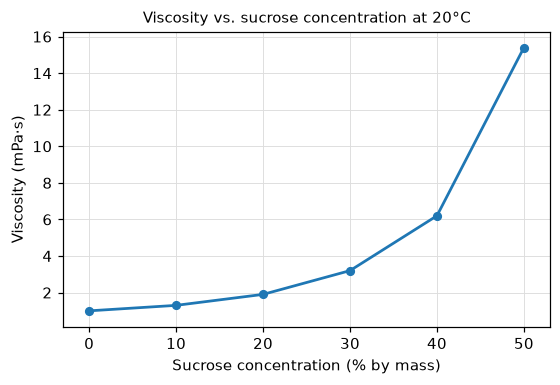
For each solution the chemist measured the density (mass per unit volume, in g/mL) with a calibrated pycnometer and the viscosity (a measure of a fluid's resistance to flow, in mPa·s) with a rotating-cylinder viscometer. The results are listed in Table 1. Figure 1 plots the viscosity of each solution against its sucrose concentration.
Table 1: Density and viscosity of aqueous sucrose solutions at 20°C
| Sucrose concentration (% by mass) | Density (g/mL) | Viscosity (mPa·s) |
|---|
| 0 | 1.00 | 1.0 |
| 10 | 1.04 | 1.3 |
| 20 | 1.08 | 1.9 |
| 30 | 1.13 | 3.2 |
| 40 | 1.18 | 6.2 |
| 50 | 1.23 | 15.4 |
Figure 1: Viscosity vs. sucrose concentration at 20°C