Salivary amylase is a digestive enzyme that breaks starch into smaller sugars. Two experiments measured how temperature and pH change the enzyme's activity.
Amylase is a digestive enzyme found in human saliva. It speeds up the breakdown of starch into smaller sugars. Researchers studied how two conditions—temperature and pH—affect the activity of purified salivary amylase.
In every trial, a fixed amount of amylase was mixed with a solution containing the same starting concentration of soluble starch. The rate of digestion was recorded as the mass of starch broken down per minute (mg/min); a higher rate indicates greater enzyme activity.
Experiment 1. The pH of every reaction mixture was held constant at 7.0. Otherwise identical mixtures were incubated at temperatures from 10°C to 70°C, and the digestion rate at each temperature was measured (Figure 1).
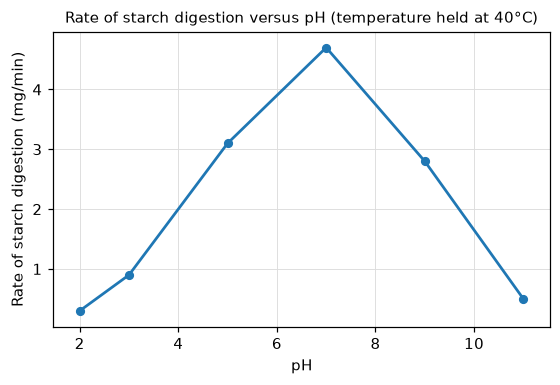
Experiment 2. The temperature of every reaction mixture was held constant at 40°C. Otherwise identical mixtures were adjusted with buffers to pH values from 2 to 11, and the digestion rate at each pH was measured (Figure 2).
Figure 1: Rate of starch digestion versus temperature (pH held at 7.0)
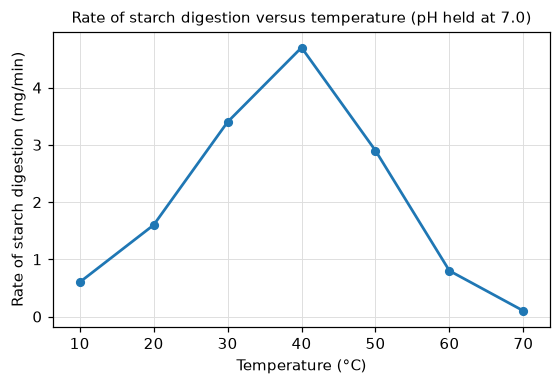
Figure 2: Rate of starch digestion versus pH (temperature held at 40°C)