A weather balloon carrying a temperature-and-pressure instrument package ascends from sea level to 15 km, recording how each quantity changes with altitude through the troposphere and into the lower stratosphere.
The lowest layer of Earth's atmosphere, the troposphere, holds most of the atmosphere's water vapor and is where nearly all weather occurs. Above it lies the stratosphere, and the boundary between the two layers is called the tropopause.
To study how conditions change with height, researchers released a weather balloon carrying a small instrument package (a radiosonde) that measured air temperature and air pressure as the balloon rose from sea level to an altitude of 15 km. Both quantities were recorded at the same set of altitudes during a single ascent, and the readings were radioed back to a ground station.
Figure 1 shows how air temperature varied with altitude. Table 1 shows how air pressure varied with altitude over the same ascent.
Figure 1: Air temperature versus altitude from sea level to 15 km.
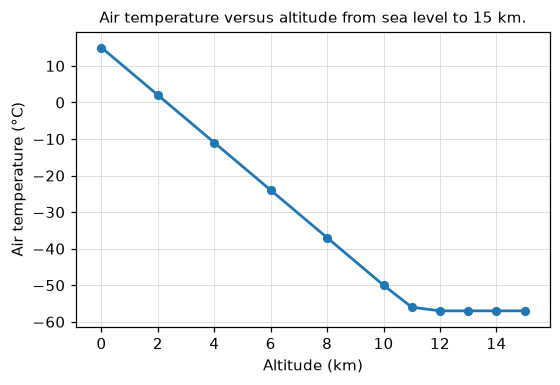
Table 1: Air pressure at selected altitudes.
| Altitude (km) | Air pressure (kPa) |
|---|
| 0 | 101 |
| 2 | 80 |
| 4 | 62 |
| 6 | 47 |
| 8 | 36 |
| 10 | 26 |
| 12 | 19 |
| 15 | 12 |