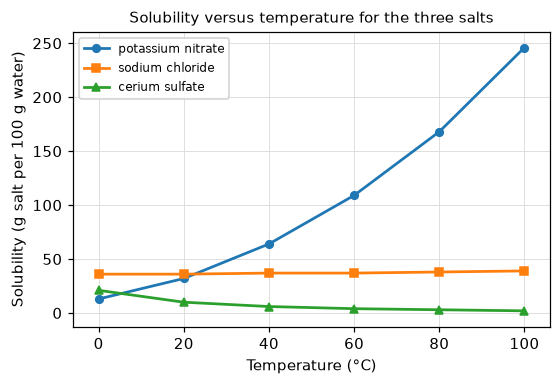
A student measured the solubility of three salts—potassium nitrate, sodium chloride, and cerium sulfate—in water at temperatures from 0°C to 100°C, where solubility is the maximum mass of a salt that will dissolve in 100 g of water at a given temperature.
Solubility is the greatest mass of a solute that can dissolve in a fixed mass of solvent at a given temperature. To compare how solubility depends on temperature for three salts, a student prepared a series of beakers, each holding exactly 100 g of pure water held at a set temperature between 0°C and 100°C.
Into each beaker the student stirred in one salt, adding more and more until no additional salt would dissolve and a small amount of undissolved solid remained at the bottom. The mass of salt that had dissolved was then recorded as the solubility, in grams of salt per 100 g of water. The procedure was repeated separately for potassium nitrate, for sodium chloride, and for cerium sulfate.
Table 1 lists the measured solubilities at four temperatures. Figure 1 plots the full set of measurements as three solubility curves.
Table 1: Solubility of each salt (g salt per 100 g water) at four temperatures
| Salt | 0°C | 20°C | 60°C | 100°C |
|---|
| potassium nitrate | 13 | 32 | 109 | 246 |
| sodium chloride | 36 | 36 | 37 | 39 |
| cerium sulfate | 21 | 10 | 4 | 2 |
Figure 1: Solubility versus temperature for the three salts