Students investigated how light affects photosynthesis in Elodea, a common freshwater plant. In each trial a fresh 5 cm sprig was placed, cut end up, in a beaker of dilute sodium bicarbonate solution (a source of dissolved CO2) held at 22 °C. Oxygen released by photosynthesis formed bubbles at the cut stem, and the students counted the bubbles produced per minute.
Photosynthesis uses light energy to convert CO2 and water into sugars, releasing O2. The pigments in a leaf do not absorb every color of light equally, and the amount of usable light also depends on how bright the light is. The students ran two experiments to separate these two effects.
Experiment 1. A lamp was set at a fixed distance from the beaker, giving a constant light intensity of 8 units (see Experiment 2). A colored filter was placed between the lamp and the beaker so that only red, green, or blue light reached the plant; a fourth trial used white light (no filter). Everything else was held constant. For each color the students recorded the O2 production rate in bubbles per minute (Table 1).
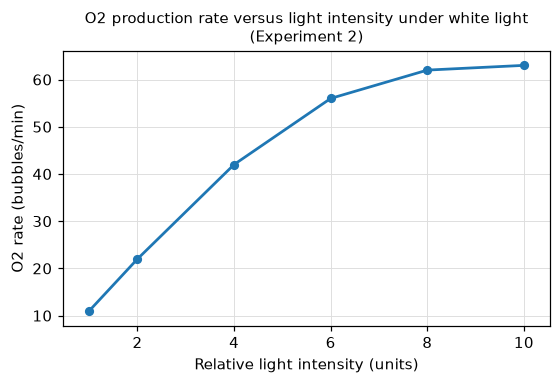
Experiment 2. The filter was removed so the plant received white light, and the lamp's distance was varied to change the light intensity reaching the beaker. Intensity was recorded in relative units (larger numbers mean brighter light, i.e., the lamp closer to the beaker). At each intensity the students recorded the O2 production rate (Figure 1). All other conditions matched Experiment 1.
Table 1: O2 production rate under four colors of light (Experiment 1; intensity = 8 units, 22 °C)
| Light color | Wavelength (nm) | O2 rate (bubbles/min) |
|---|
| Red | 650 | 54 |
| Green | 540 | 16 |
| Blue | 450 | 48 |
| White | full spectrum | 62 |
Figure 1: O2 production rate versus light intensity under white light (Experiment 2)